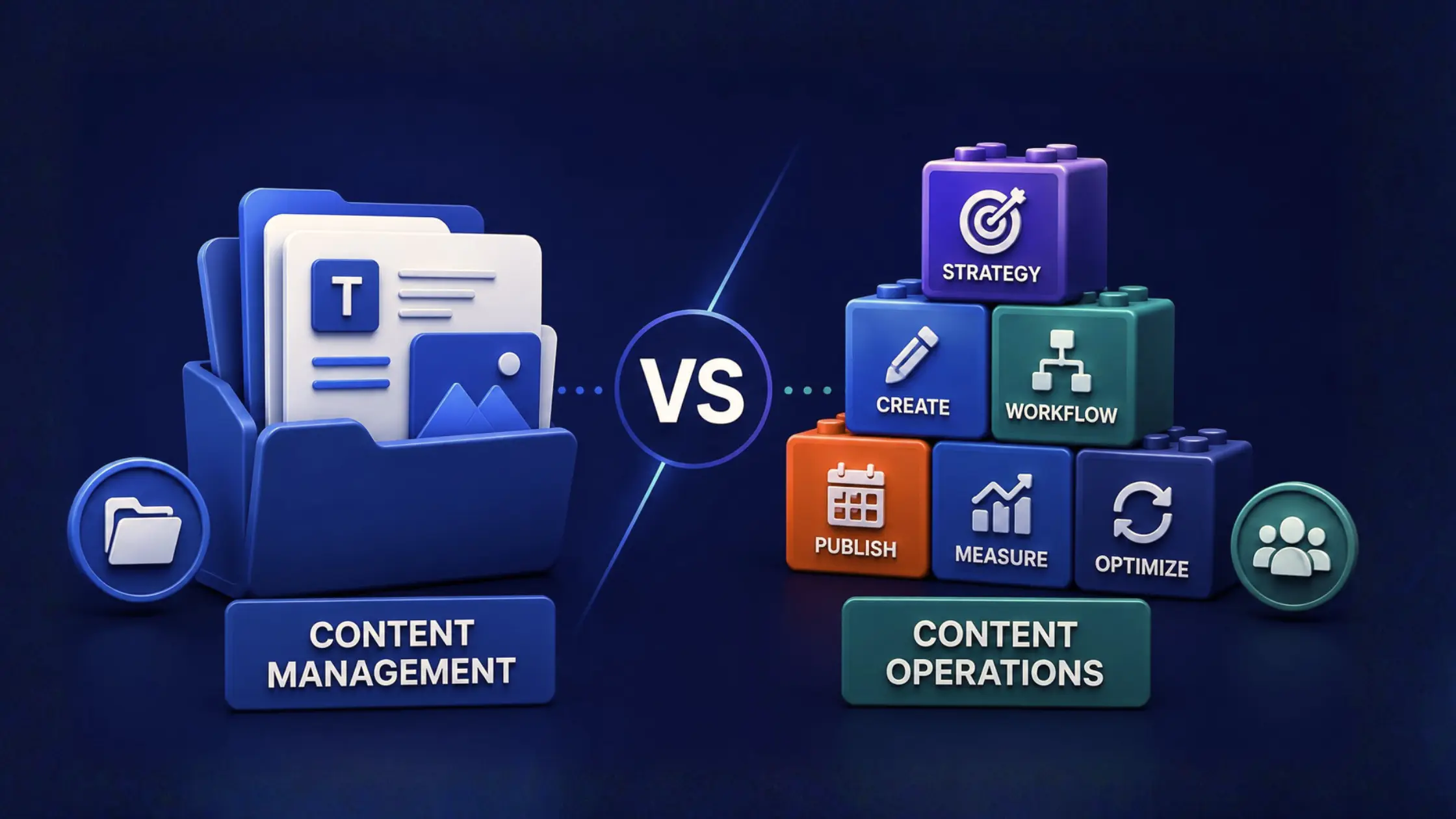
Content management is the platform and the act of storing, editing, and publishing content. Content operations is the discipline of running all of that reliably, day after day: the people, the process, the governance, the quality, and the speed. Put simply, content management is the system. Content operations is what keeps the system delivering after everyone who built it has moved on.
Why the Distinction Actually Matters
The distinction sounds academic until you have lived through the gap between them. Plenty of enterprises own a capable content management system, and still cannot get a page published quickly, keep translations in parity, or stop the site from slowly falling out of date. The platform is fine. What is missing is the operation around it.
What Content Management Actually Is
Content management is your CMS and the work it enables. Sitecore, Contentful, AEM, WordPress Enterprise: these are content management systems. They give you a place to create content, a way to structure it, and a mechanism to publish it. When people say they "have Sitecore," they mean they have content management. It is necessary, and it is where most of the budget and attention goes. The trouble is that owning a content management system is often treated as the finish line. It is not. It is the starting point.
What Content Operations Actually Is
Content operations is the discipline of running the platform well, every day, at scale. It covers who can request content and how, who publishes and how fast, how quality holds when volume rises, how translations stay in sync across markets, how the content structure stays clean, and how nothing important gets lost.
Content management gives you the ability to publish. Content operations makes publishing predictable. If content management answers "can we publish this," content operations answers "can we publish this correctly, quickly, and consistently, a thousand times a year, without it becoming a mess."
The Difference in One View
When content management is missing, you cannot publish at all. When content operations is missing, you publish slowly, inconsistently, and with growing risk.
What the Gap Costs You

Most enterprises invest heavily in the platform side and almost nothing in the operations side. That is the pattern behind so many stalled digital programs. The platform works, but publishing is slow. The system is powerful, but the team is stretched. The technology is current, but the content is drifting out of date. None of that is a content management failure. It is the absence of content operations.
The Cost of the Gap Is Real
Backlogs grow because there is no reliable intake and prioritization. Developers get pulled into routine edits because no operations layer owns them. Translations fall out of parity because nobody is accountable for keeping them aligned. Quality slips as volume rises because there is no system holding it. Each of these traces back to the same missing discipline.
Why Implementation and Operations Are Two Different Jobs
This is also why implementation and operations are two different jobs. Implementation partners build the platform and hand it over. That is content management, delivered and done. Running it well, day after day, is content operations, and it does not stop. Both matter. Confusing one for the other is how good platforms end up underused.
What This Looks Like in Practice
On one global manufacturer program, the platform had been in place for years. What changed the outcome was the operation built around it: a clear intake, defined quality standards, and governance that held quality at 99.5% accuracy while keeping translations in parity across five languages, with publishing measured in hours instead of days. Same content management system. A completely different result, because of content operations.
The Short Version
Content management is the system you buy. Content operations is the discipline you run. You need both, but only one of them was ever going to keep your site moving after launch, and it is the one most enterprises forget to invest in.

Content management is the platform and the act of storing, editing, and publishing content. Content operations is the discipline of running it reliably at scale, covering people, process, governance, quality, and speed. The system is content management. Keeping the system delivering is content operations.
A dedicated content operations team or partner, distinct from the developers and implementation partners who build the platform. Implementation delivers content management at launch. Content operations runs it every day after.
Because the platform alone does not keep content moving. Without content operations, enterprises face growing backlogs, slow publishing, translation drift, and quality issues, even on a strong CMS. The discipline is what turns platform capability into consistent output.
Content intake and prioritization, authoring and editing, workflow management, quality assurance, translation and multilingual parity, publishing, platform maintenance, governance, taxonomy and metadata management, analytics setup and reporting, and continuous improvement. Not any single one of these, but all of them, held together as a discipline.
Yes. Implementation partners are engaged for platform work: enhancements, integrations, upgrades. That is different from daily content operations, which is high-volume, high-frequency, and requires a different skillset and cost structure than platform engineering. Most enterprises need both, and the two do not substitute for each other.

.webp)