5 Ways to Make Enterprise Content Easier for AI to Understand
Enterprise websites carry thousands of pages: product details, technical documents, knowledge articles and resources, often spread across several platforms, regions and languages. That content may serve customers well. But when it is inconsistent, loosely structured or out of date, it becomes hard to maintain and hard for any system, human or machine, to interpret.
AI-powered search and digital assistants increasingly bring information from websites into their answers, sometimes before people ever visit the original page. So the question is no longer only “is this page published?” It is “is this page clear, current and easy to interpret without us in the room?”

The short answer: Making enterprise content easier for AI to understand starts with the same foundations good content operations already need. Clear structure, consistent terminology and metadata, governance that keeps facts current, technical SEO that keeps pages discoverable, and measurement that tells you what to fix next. Google says websites do not need special AI markup, files or content formats to appear in its AI search features. The same SEO fundamentals still matter: useful content, accessible pages and information that search systems can understand.
How to Make Enterprise Content AI-Ready
Making enterprise content AI-ready starts with how your team structures, publishes and maintains it. These five practices cover clear page structure, consistent metadata, content governance, technical SEO and measurement, giving content teams practical steps to make information easier for AI systems to interpret and users to navigate.
1. Structure every page around a clear topic and the questions people ask
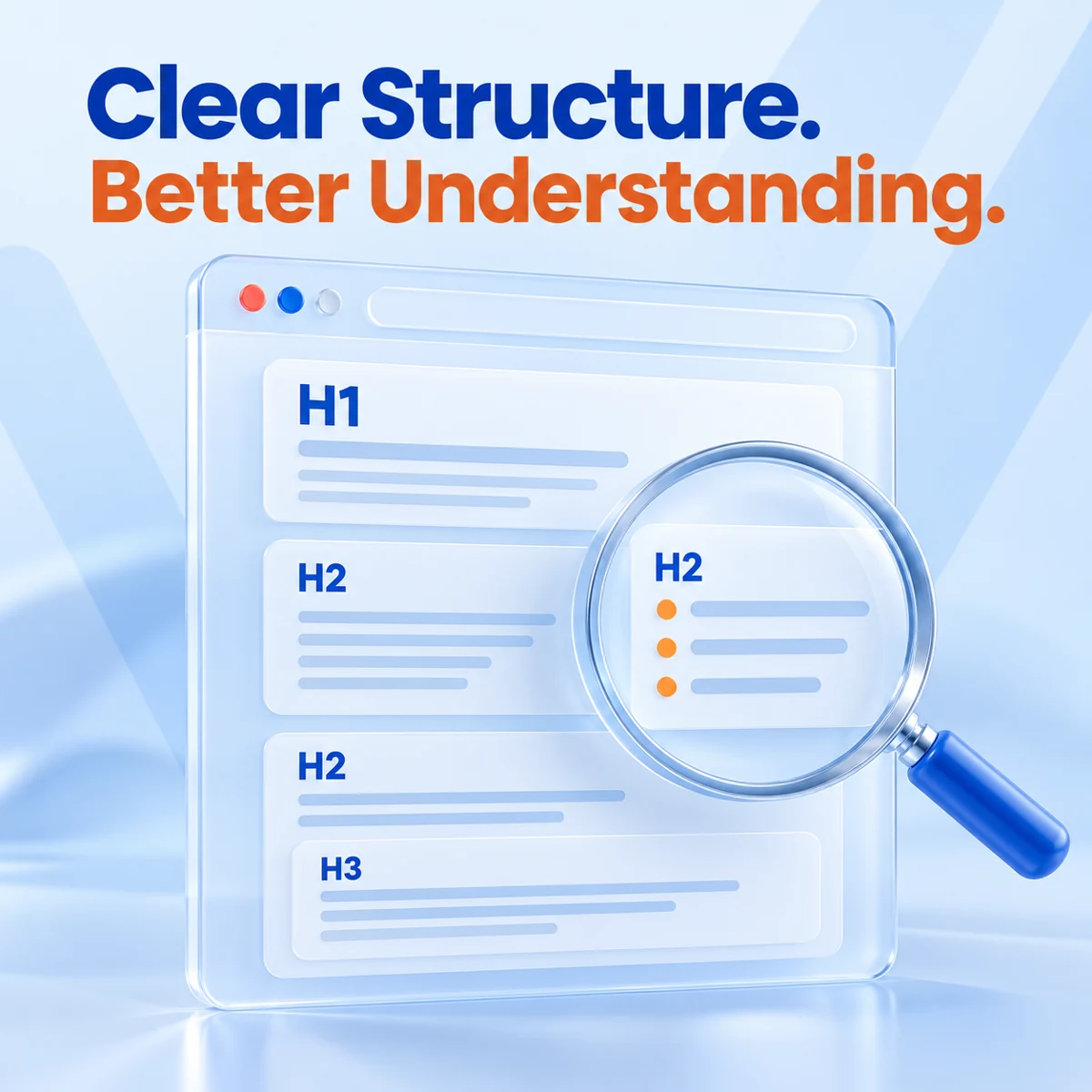
Structure helps readers find answers, and it helps search systems understand what a page covers. When one long page mixes several unrelated topics, readers struggle and systems have to guess which part matters.
Start by giving every page one clear purpose. Consider a fictional industrial equipment manufacturer whose pump product page covers specifications, installation steps, maintenance intervals, safety notes and industry use cases in one unbroken block. Splitting that into descriptive sections lets an engineer jump straight to maintenance intervals, and lets a search system see that the page answers that question.
How to improve structure
- Use a clear H1 that describes the page’s main topic.
- Organise supporting information under descriptive H2 and H3 headings.
- Answer the most important customer question directly near the top, then explain the detail underneath.
- Use lists, tables and step-by-step instructions where they genuinely make things clearer.
- Keep each page focused on one audience, topic or need.
- Link to related pages that add context, rather than repeating them.
There is no need to cut pages into artificial “AI-sized” fragments. Google states its systems can understand multiple topics on a page. Clear headings help because they help people.
2. Use descriptive metadata and consistent terminology
Large organisations often use several names for the same product, service or concept. One page says “industrial pumps”, another says “fluid transfer solutions”, a regional site says something else again. Readers get confused, and related pages stop looking related.
Metadata adds context: page titles, meta descriptions, image alt text and, where relevant, structured data. Inside a CMS, structured content fields help teams keep that information consistent across pages, sites and channels.
How to improve metadata and terminology
- Write page titles that describe the content accurately.
- Write meta descriptions that tell visitors what they will find.
- Add meaningful alt text to informative images.
- Agree on consistent names for products, services and categories, and keep approved regional variations in a shared glossary.
- Apply structured data only where it fits, and make sure it matches what visitors can read on the page.
- Keep the same metadata rules across regional sites and language versions.
If two terms really do mean the same thing, say so on the page instead of switching between them. Metadata should describe the content, not repeat keywords. And structured data can help systems interpret eligible content, but it does not guarantee a place in an AI-generated answer.
3. Build governance and quality checks into daily publishing
AI-ready content is not only about how information is written. It is about whether it is accurate, current and consistent everywhere it appears.
When several teams publish across regions, business units and sites, pages drift apart. One page has the new specification, another has last year’s. A translated page still carries an old claim. A duplicate page nobody owns keeps ranking. Each of these creates confusion for readers and makes it harder for search and AI systems to identify which information is current.
How to strengthen governance
- Name an owner and an approver for every important page or content type.
- Keep editorial and terminology guidelines short, current and easy to find.
- Review high-value pages on a schedule, not only when something breaks.
- Use version control and a publishing workflow that matches the risk of the content.
- Find and resolve outdated, duplicate and conflicting pages.
- Run quality checks before anything is published.
- Write down how AI-assisted content is reviewed and who signs it off.
Multilingual sites make this visible quickly. In one global manufacturing program we support, managing 325 translations across five languages depended less on writing speed and more on process: knowing which pages a change affects, tracking the required translations, validating the content and publishing the approved updates in the right markets. That is multilingual content operations in practice, and the same discipline helps reduce conflicting information across the pages that search and AI systems may discover.
Governance works when it is part of daily enterprise content operations, not a cleanup project once a year.
4. Make important content discoverable through technical SEO
Well-written content still struggles if search engines cannot reach it. Technical SEO keeps the foundation in place: important pages can be crawled and indexed, internal links connect related information, and the site works well on every device. These basics matter just as much now that search engines show AI-generated features.
Technical SEO practices to prioritise
- Confirm important pages are accessible to crawlers and not blocked by mistake.
- Check indexing status and fix unintended noindex or canonical problems.
- Use descriptive URLs and logical navigation.
- Link related articles, service pages, product pages and resources to each other.
- Resolve duplicate content and check canonical tags.
- Keep important information in readable text, not only inside images or PDFs.
- Improve mobile usability, page performance and accessibility.
- Validate structured data where it is used.
A common pattern: a team publishes genuinely useful technical resources, but the pages are orphaned, blocked from crawling or buried several clicks deep. These gaps make useful content harder to discover, reducing its chances of reaching readers or appearing in relevant search results. A technical SEO review can help uncover these gaps. Some are straightforward to fix, while others need changes to the CMS, templates or publishing process. For a closer look at how this fits a wider search and AI visibility approach, see our earlier guide, From Google to Generative Search.
No single technical change guarantees inclusion in AI results. Google’s guidance keeps returning to the same point: accessible pages, useful content and established SEO practice.
5. Connect content operations to continuous measurement
Websites change constantly. Products launch, services change, new markets open. Without regular measurement, content improvements become inconsistent and nobody can say whether they worked.
What to measure
- Use Google Search Console to understand how people discover your content through Google Search, including available reporting for AI search features. Where supported, use Bing Webmaster Tools to review how your pages appear as sources in AI-generated answers.
- Organic traffic and meaningful conversions in Google Analytics 4.
- Accuracy and freshness of your highest-value pages.
- Publishing turnaround time and the issues your quality checks catch.
Keep traditional search performance and AI visibility as separate lines in your reporting. They are related, but they are not the same outcome, and no single tool shows visibility across every AI assistant. Use what the data shows to find gaps, update weak pages, improve internal links and focus on the questions customers actually ask. The next step is turning those findings into specific CMS tasks, so content teams know what needs to change and where to start.
Where to start?
You do not have to fix everything at once. Start with the pages that matter most to your customers, whether those are product pages, technical resources or key service pages. Check how they are structured, whether the information is current, and whether search engines can find them. Then turn what you learn into a repeatable checklist for the next set of pages.
A foundation, not a rewrite
Making enterprise content easier for AI to understand does not mean rewriting every page or changing platforms. It means clear structure, reliable metadata, consistent governance, accessible pages and steady measurement, working together across teams, sites, languages and publishing workflows.
That is ordinary good content operations. The difference now is that more of your audience meets your content through a machine’s summary first, so gaps that were once minor become visible faster.

Clear page structure, consistent terminology, accurate metadata, current facts and pages that search engines can crawl and index. These are the same foundations that make content useful for people. Google states that no special AI schema, file or content format is required for its generative search features.
Not for Google’s generative search features, according to Google’s own guidance. Use structured data where it accurately describes visible content and supports a legitimate search feature, not as a way to chase AI citations.
When different pages give different answers, AI systems can pick the wrong one. Governance (named owners, review cycles, quality checks and clear terminology) keeps one current version of each fact across pages, sites and languages.
Use Google Search Console’s generative AI performance report for impressions in Google’s AI features, and Bing Webmaster Tools’ AI Performance report for citations in Microsoft Copilot and Bing. Neither covers every AI assistant, so report them separately from traditional search data and avoid combining them into a single score.